


Artificial intelligence, despite having only become a mainstream phenomenon in the last few years, has already fundamentally changed how we learn, work, communicate, shop, create, and make decisions. It has applications in everything from healthcare to finance, agriculture to entertainment.
But who gets to build it?
Right now, unfortunately, not nearly enough women and girls.
AI system designers have an impact on many aspects of this industry. They decide which data is important for people to see, which problems need solving, and how AI systems interact with the people who use them, either for professional or personal use. When women are underrepresented in this work, the AI industry misses out on crucial experience and talent, not to mention their perspectives. All these things shape the future of AI and shape how useful and equitable these systems are.
From an early age, girls face this imbalance due to lack of exposure to coding and engineering. With this disparity, girls are less likely to picture themselves pursuing careers in these fields later. Girls benefit from seeing women working and excelling in these fields, and the lack of women in AI lessens the chance these girls will enter these careers later.
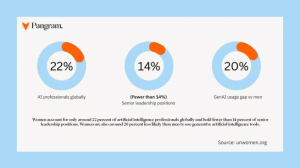
There’s still a long way to go. Presently, women make up only about 35% of STEM graduates worldwide, according to UNESCO. They also represent only about a third of researchers globally. The World Economic Forum similarly reports that women account for just 28.2% of STEM roles and only 12.2% of STEM C-suite positions.
Considering that women aren’t underrepresented in higher education or the workforce generally, these figures are appalling. Even though women graduates outnumber men in most countries, fewer women are going into AI roles, and if they do, they are less likely to reach the C-level. Additionally, women are more likely to have roles disrupted by AI and their jobs are less likely to be augmented by AI use, as opposed to men.
The problem is a lack of access and exposure, and these barriers come up long before a woman applies for her first job in tech. Girls face stereotypes related to their abilities in math and engineering, and they may have fewer female teachers and professionals to look up to. Some women just are not provided with the same opportunities to experiment with new technologies at a young age when they are first developing their interests and confidence.
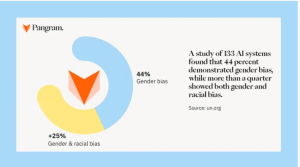
AI reinforces those biases. Models are trained on data that’s created by people and existing institutions, which means they can unknowingly reproduce biases already present in society. Representation is the silver bullet: teams with a broader, more diverse range of experiences are better positioned to spot problems, challenge assumptions, and ask questions that might otherwise be missed.
Despite the challenges (and the unforgiving stats), programs around the world are creating more ways for girls to enter STEM and technology fields. In 2025, UNESCO recognized All Girls Code, a program that provides free coding, emerging technology, leadership, and mentorship opportunities to more than 2,500 girls in nine countries.
Young girls now have more entry points into male-dominated tech fields than ever before. A middle school student can learn coding online, or join a robotics team or AI club. College students can pursue research, hackathons, internships and mentorship.
And AI careers extend well beyond software engineering. The field needs developers, but it also needs researchers, product designers, cybersecurity specialists, policy experts, educators, ethicists, and communicators. Students who are interested in technology but don’t see themselves as programmers may still find plenty of ways to contribute, too.
As AI changes the labor market, we’re finding that women are overrepresented in some occupations that are more vulnerable to disruption from generative AI. Teaching women and girls how to use new technology is important, but just as important is giving them opportunities to build it, challenge it, improve it, and help decide how it will be used.
These resources are helping to create those kinds of opportunities:
Research
Women are underrepresented in the field of AI. This article addresses the obstacles to inclusion and examines the role of empowerment in supporting women’s participation in AI.
Women in AI: Barriers and Solutions
This paper discusses the negative impact that the lack of women involved in AI has had on the field’s development. It suggests some ways to close the gender gap within the field.
Gender Bias in Artificial Intelligence: Empowering Women Through Digital Literacy
This study combines the findings from research on gender bias in AI from 2010 through 2024. It also addresses digital literacy initiatives and reports on their effectiveness in addressing the disparities.
Gender inequality in the sphere of artificial intelligence: Theoretical approach
Researchers have found that as of 2024, only 20% of those working in AI are women. This study reviews existing articles to gain a deeper understanding of what is causing this.
There is a big gender gap within the tourism industry. This article discusses the role AI could play in potentially closing the gap, particularly by helping detect bias.
Artificial Intelligence: An Untapped Opportunity for Equity and Access in STEM Education
This article discusses different ways that AI can be utilized to help students with disabilities, particularly in STEM subjects.
Gender differences in artificial intelligence: the role of artificial intelligence anxiety
This study finds that women are more likely than men to have AI anxiety. This information lays the groundwork for addressing gender disparity within different AI fields.
The gender disparity within AI usage and understanding can be seen even at the elementary school level. This study addresses the impact that AI Literacy Courses can have on closing the gap.
This study finds that male researchers use generative AI more frequently than female researchers, resulting in a disparity in productivity levels. It also discusses potential solutions for this issue.
This study addresses the fact that since men and women view and understand AI differently, it is important to consider both perspectives when developing AI curriculum.
Organizations
We Are Women in AI is an organization dedicated to educating and supporting women who work in the field of AI.
Women in AI is a network designed for female leaders and executives within the field of AI. Its mission is to educate and empower women in order to help close the gender gap.
AI Women Leaders is a nonprofit organization committed to empowering women who work in the AI field. It provides education, support, and networking opportunities.
Women in AI + ED is a community of women who work in the field of Education and are using AI to enhance their teaching and create new opportunities.
Women in AI Governance is a community that is focused on empowering women who are working in the field of AI Governance.
Women in AI Ethics is an organization committed to helping close the gender disparity within AI and STEM fields through education, outreach, and action.
AI-Powered Women is committed to training women to serve in leadership roles in AI. They offer conferences and courses developed by women.
Women Shaping AI is an organization designed to educate and empower women to develop the necessary skills to thrive in the AI industry.
Girls in AI uses podcasts and partnerships with schools to inspire teenage girls to seek education and careers in the field of AI.
Women Defining AI provides workshops and training for women interested in pursuing a career in AI.
Articles
AI might be making women sound bad at work | Hub
Studies have shown that when AI picks up on the patterns of speech typically used by women, they produce less sophisticated and professional emails.
Mind the Gap – Why AI Needs Women Now
This article discusses how the gender discrepancy in AI introduces skewed data to the models and negatively impacts the development of AI.
AI is advancing fast. Women are being left behind in the workforce and leadership.
This article from UN Women discusses the fact that women make up less than 25% of the AI workforce, and hold less than 15% of the leadership positions.
Women Are Avoiding AI. Will Their Careers Suffer? | Working Knowledge
This article from Harvard Business School discusses the fact that women are not as willing to use generative AI in the workplace and looks at what impact it may have on their careers.
Where are all the Women in AI?
This article discusses some of the reasons for the gender discrepancy in the field of AI including hiring biases, lack of role models, and an unsupportive culture.
Report: Where are the women? Mapping the gender job gap in AI | The Alan Turing Institute
This policy briefing from the Alan Turing Institute highlights the discrepancy between men and women in the AI field, focusing on areas such as salary, training, and education.
Women Are 26% Of AI Hires. That’s A Design Flaw, Not A Shortage
This Forbes article discusses the gender bias in AI fields and suggests solutions such as increased auditing and more incentives for fair hiring practices.
AI’s Anti-Woman Problem | Washington Monthly
This article discusses gender bias within AI models, focusing on the implications in the workplace, such as AI favoring male job candidates, and the underrepresentation of women’s viewpoints when training AI models.
Women are being left behind in high-paying AI jobs boom, LinkedIn study finds – CBS News
This CBS article addresses the “Broken Ladder” for women in AI Roles and suggests that hiring based on skills rather than experience could potentially help close the gender gap.
Source: https://www.pangram.com/blog/women-in-ai