



The recovery of nine women’s bodies in Ekurhuleni has sharpened a national question: would recognising femicide in law improve investigations, accountability and prevention?
The recovery of nine women’s bodies across Ekurhuleni between July and September 2026 is more than a cluster of unresolved deaths. It is a warning about the distance between South Africa’s recognition of gender-based violence and femicide as a national disaster and the state’s ability to prevent, investigate and prosecute gender-related killings. As of 20 September, eight of the women had been identified, seven families had been informed, three people had been questioned, and one arrest had been made in connection with the first July case. Police had not concluded that a single offender was responsible.
The bodies were found in areas including Kempton Park, Pomona, Olifantsfontein, Rhodesfield, Clayville, Kwa-Thema and Dawn Park/Boksburg. Publicly named victims included Elizabeth “Tsontso” Moselakgomo, 38; Itumeleng Kekana, 32; Dineo Evelyn Motapane, 38; and Gracious Nkomo, 28. Beyond the immediate grief of their families, the cases have changed how women move through their neighbourhoods and raised urgent questions about missing-person responses, crime-scene coordination, forensic capacity and whether investigators consistently test for gender-related circumstances.
The scale of the problem
The figures show that Ekurhuleni is part of a much wider crisis. SAPS recorded 5,427 murders nationally between April and June 2026. Citing police data, the South African Human Rights Commission reported that 569 women were murdered and 1,052 survived attempted murder during the same period. SAPS also recorded 9,201 rapes in the quarter. These are reported cases, not the full prevalence of violence.
The South African Medical Research Council’s fourth national mortuary study provides the clearest picture of the gendered pattern. For 2020/21, it estimated that 60.1% of women who were victims of possible femicide were killed by an intimate partner; that’s about three women a day. One in six women showed evidence of sexual violence, a strong indicator for femicide. Fewer than one in five intimate partner femicide cases resulted in a conviction, while the perpetrator was not prosecuted in 44.2% of femicide cases, up from 30% in 2017.
Defining femicide
South African law currently prosecutes femicide as common-law murder. Domestic abuse, sexual violence and premeditation may influence bail, proof and sentence, but the charge itself does not consistently record the gendered circumstances of a killing. Classifying femicide as a standalone offence could make those circumstances visible in police files, court records and national statistics. It would also affirm the constitutional rights to equality, dignity, life, and freedom and security of the person, including freedom from violence from public or private sources.
A workable definition should rely on objective indicators rather than proof of an offender’s private motive alone. These could include a current or former intimate relationship; prior coercive control, stalking, threats or abuse; sexual violence; trafficking or exploitation; misogynistic conduct; punishment for asserting autonomy; disappearance; mutilation; concealment; or public disposal of a body. Every violent or unexplained death of a woman or girl should be examined from the outset for such circumstances.
Benefits of making femicide a stand-alone crime
Criminalisation, however, must not be mistaken for a sentencing slogan. A credible Femicide Act would require immediate searches for missing women and girls, links between missing-person and domestic-violence records, specialist police and prosecutors, rapid forensic support, family liaison and disaggregated public data. It should provide independent review where officials obstruct investigations, lose evidence or act negligently or discriminatorily. Parliament would also need to attach ring-fenced, multi-year funding for prevention, shelters, social services, forensic laboratories and courts.
International experience offers useful lessons. Eighteen Latin American countries have criminalised femicide, feminicide or gender-related killing. Mexico’s federal offence identifies circumstances such as prior violence, disappearance, exploitation and public exposure of the body, and allows sanctions against officials who maliciously or negligently delay justice. Colombia created an autonomous offence in 2015. Spain, while not defining femicide as a separate offence, has developed specialist courts, prosecutors, protection orders, risk assessment and electronic monitoring.
Towards enforceable law
These examples also carry a warning: naming the crime does not automatically end it. Comparative research points to gains in recognition, classification, public awareness and institutional accountability, but uneven implementation and persistent impunity remain common. South Africa should therefore avoid importing a label without the machinery to enforce it. The purpose of reform must be earlier intervention, better evidence, consistent investigation and measurable state responsibility, not punishment alone.
After GBVF was classified as a national disaster in November 2025, the next step must be enforceable law. Parliament should develop a constitutionally sound, women-led model bill through public hearings, expert review and consultation with affected families and communities. An independent femicide observatory should track cases, budgets, delays and outcomes. The Ekurhuleni deaths underline the urgency that femicide is not adequately understood as ordinary murder when gendered violence shapes the pathway to death and the failures that follow.
South Africa needs a law that names the crime, funds the response and makes every institution answerable for action. Thus far, Amnesty International and other human rights groups make a similar call. With local knocking on the doors of parliament, perhaps the empty speak of the president to declarations of GBVF as a national disaster could be concretised by the declaration of femicide as a stand-alone gender-violence crime against women.
Lara Reddy is a Tamil South African anarcho-feminist activist and popular educator spanning 30 years’ experience in High School education. She is a writer, international women’s organiser and poet who primarily works as a Researcher and Education Officer at the International Labour Research and Education Group (ILRIG) in Johannesburg. Her work spans grassroots community organising, popular education, anti-capitalist solidarity, and social justice advocacy, with a strong feminist ethos, together with her mutual aid work with Food Not Bombs Jozie.
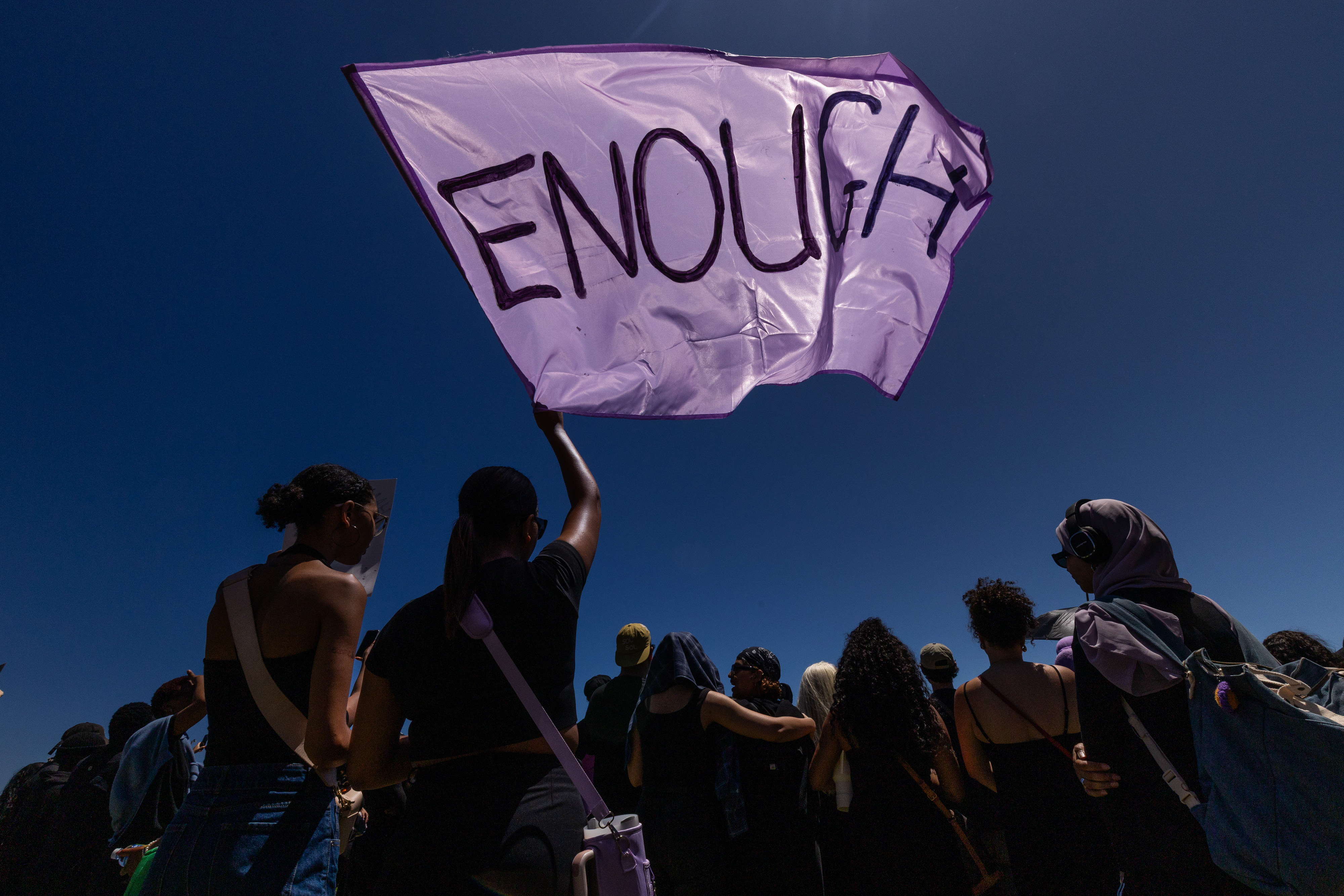
*Featured Image by Ashraf Hendricks/GroundUp
Source: https://www.amandla.org.za/case-for-femicide-as-a-standalone-crime-in-south-africa/